
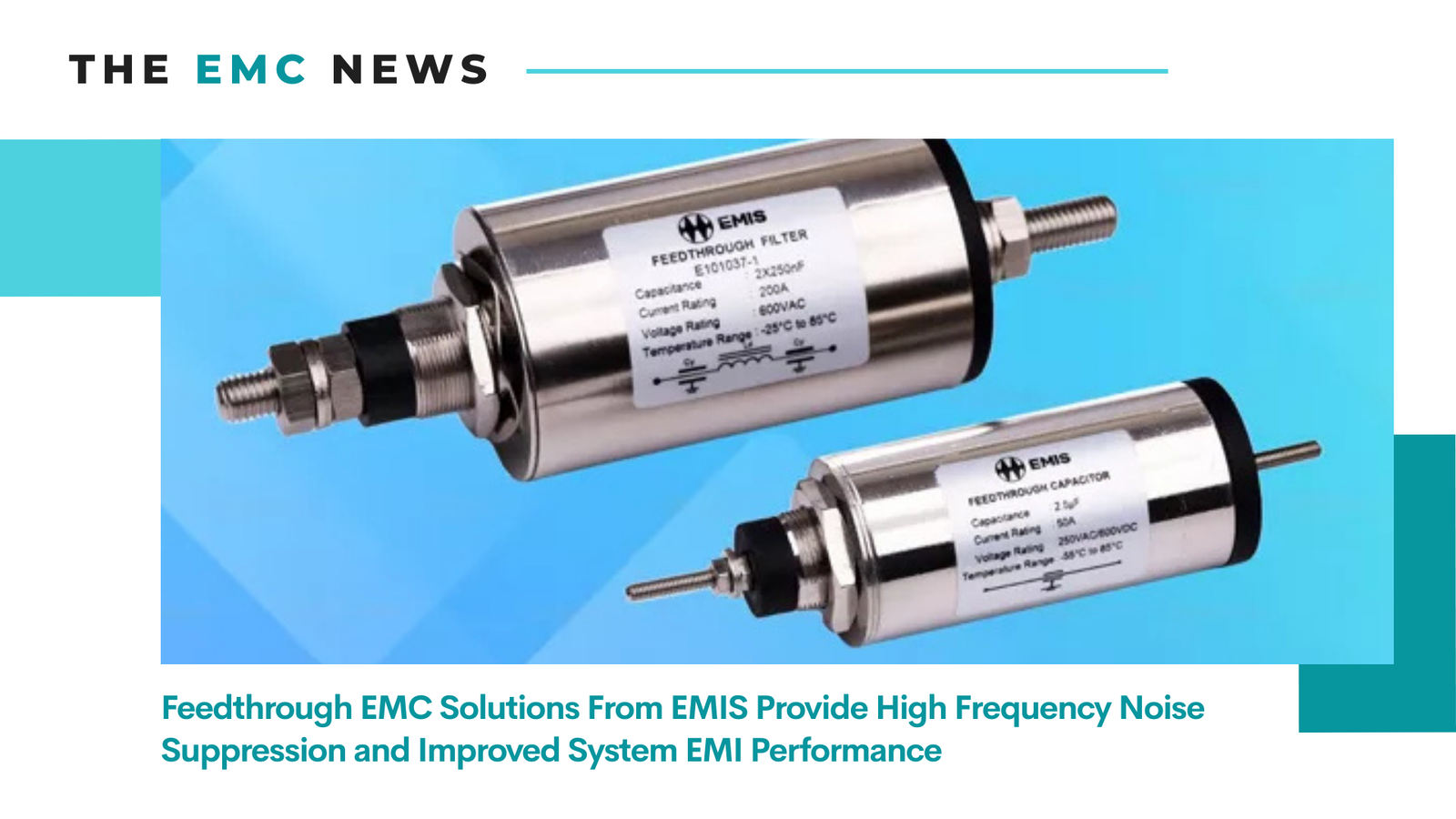
EMC solutions provider EMIS offers a range of feedthrough components designed to pass conductors through a grounded barrier while providing high frequency noise suppression and improved EMC performance.
Feedthrough capacitors are a single capacitor mounted through a metal panel or chassis, allowing a signal or power conductor to pass while shunting high frequency noise to ground. This is highly effective at suppressing high frequency interference from approximately the kilohertz region up to the gigahertz range, depending on the construction and installation.
Related Resources
The component provides a low impedance path to ground for unwanted high frequency signals, improving insertion loss at higher frequencies compared with standard two-lead capacitors. It helps prevent radio-frequency interference from entering or leaving shielded equipment and enclosures.
The design offers high reliability and mechanical robustness, suitable for harsh environments such as aerospace, military, industrial and medical systems. Components are usually threaded for bulkhead mounting, ensuring a secure
mechanical fit and a low impedance ground connection to the chassis or panel. The capacitor shell must be bonded firmly to the metalwork to maintain effective high frequency noise suppression; poor grounding significantly reduces performance.
Key features of feedthrough capacitors include:
Typical current ratings to approximately 200A and AC voltages up to 250VAC, depending on type and size
Capacitance values are available from approximately 2.2 to 4700 nF to support a wide range of impedance and attenuation requirements
Devices are designed in accordance with IEC/EN 60384-14 for safety-related capacitors
Specified torque should be applied to threaded terminals and nuts to avoid mechanical damage and to guarantee stable contact resistance over lifetime
Versions are available that meet EMC and safety-relevant capacitor classes (Y2) and/or specific pulse-test or surge requirements.
A feedthrough filter integrates capacitors and inductors, and in some design’s resistors, into a single housing to provide broadband attenuation of conducted noise. Compared to a single Feedthrough capacitor, it offers higher insertion loss over a wider frequency range, often extending to lower frequencies where line impedance dominates.
Key features of feedthrough filters include:
Typical electrical ratings cover up to approximately 200A and AC voltages up to 250VAC, depending on the selected series
Capacitance options generally range from about 10 to 4700 nF to optimise performance across different load conditions and noise spectra
Designs comply with standards such as UL 60939-3, IEC 60939-1&2 and CSA C22.2 No. 8 for passive EMC filter components.
Feedthrough EMC components have a wide range of applications such as:
RF & Communication Systems: preventing RF coupling through control and power penetrations in RF circuits, RF communication equipment, telecom base stations
Power & Energy: reduce conducted emissions and improve immunity in switched-mode power supplies, UPS systems, battery charging equipment and electrical machines and drives
Aerospace & Military: where high reliability feedthroughs are required at bulkhead interfaces for avionics, radar, communication and mission-critical electronics
Digital & Control Systems: high speed digital electronics, motor drives, robotics, PLC panels, as well as analogue and digital I/O lines that cross shielding boundaries
EMC & Interference Protection: broadband interference suppression for equipment needing stringent EMC compliance, including use in EMC chambers and shielded rooms
Medical Devices: implantable and external medical devices such as pacemakers and neurostimulators, where low leakage and high reliability are critical
Noise Reduction in Panels: suppression of noise on sensor, actuator, and control wiring routed near motors, inverters and other high-power switching elements
Environmental Protection: sealed bulkhead feedthroughs are used to maintain environmental integrity while providing EMC filtering in harsh or outdoor conditions
Networking & Communication: where interfaces must pass through shielded enclosures without degrading EMC performance.