
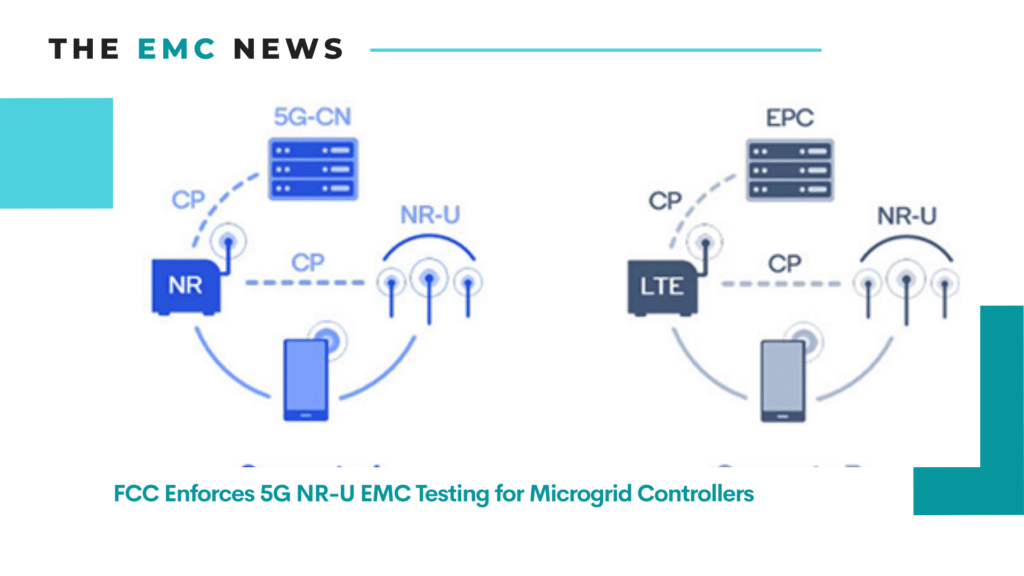
Effective May 18, 2026, the U.S. Federal Communications Commission (FCC) has mandated electromagnetic compatibility (EMC) immunity testing for microgrid controllers operating in the 5G NR-U band (6 GHz U-NII-5/6) — a requirement directly impacting manufacturers exporting to the U.S. market, especially those based in China. This regulatory shift affects product certification timelines, bill-of-materials (BOM) costs, and hardware design strategies across the microgrid control equipment supply chain.
Event Overview
On May 18, 2026, at 00:00 ET, the FCC’s KDB 996369 D07 v1.2 guidance became mandatory. Under this rule, all microgrid controllers marketed or imported into the United States must pass EMC immunity testing specific to the 5G NR-U frequency bands (U-NII-5 and U-NII-6 within the 6 GHz spectrum). Devices failing this requirement are prohibited from bearing an FCC ID.
Industries Affected by Segment
Direct Exporters (U.S.-bound Equipment Manufacturers)
Manufacturers exporting microgrid controllers to the U.S. are directly subject to the new compliance obligation. Non-compliant units cannot receive FCC ID authorization, blocking market access. Certification delays may arise due to added test cycles, especially where existing designs lack shielding or filtering for 6 GHz NR-U interference.
OEMs Relying on Third-Party RF Modules
Small and mid-sized enterprises using off-the-shelf 5G or Wi-Fi 6E RF modules face elevated risk. If those modules were not qualified for NR-U band immunity under KDB 996369 D07 v1.2, full-system retesting — and potentially board-level redesign — becomes necessary. This impacts time-to-market and unit cost more acutely than for vertically integrated vendors.
Component Suppliers (EMC-Critical Subsystems)
Suppliers of power management ICs, isolation amplifiers, communication interfaces (e.g., RS-485 transceivers), and PCB-level EMI filters may see revised technical specifications from OEM clients. Demand could rise for components with documented 6 GHz immunity performance — though no new component-level standard is introduced by the FCC rule itself.
What Relevant Enterprises or Practitioners Should Monitor and Do Now
Track official FCC and TCB interpretations of KDB 996369 D07 v1.2
The KDB document provides measurement procedures but leaves room for test lab discretion on setup configurations (e.g., field uniformity validation, modulation schemes). Enterprises should monitor bulletins from accredited Telecommunication Certification Bodies (TCBs) and the FCC’s Office of Engineering and Technology (OET) for clarifications affecting test repeatability and pass/fail thresholds.
Review current controller designs against NR-U band coupling paths
Analysis shows that conducted and radiated immunity vulnerabilities often originate at I/O ports, power rails, and unshielded control signal traces. Engineers should prioritize reviewing layouts for susceptibility to 6 GHz common-mode currents — particularly in systems with external sensors, wireless gateways, or Ethernet interfaces located near antenna zones.
Assess reliance on third-party RF modules and validate their NR-U immunity documentation
Observably, many commercially available 6 GHz-capable modules carry only emissions (radiated/conducted) certifications — not immunity. Procurement teams should request full EMC immunity reports covering the U-NII-5/6 bands, referencing KDB 996369 D07 v1.2 test setups, before committing to module integration.
Update internal certification roadmaps to include 6 GHz NR-U immunity as a gating step
For products scheduled for U.S. launch between Q3 2026 and Q2 2027, adding NR-U immunity testing early in the design verification phase avoids last-minute redesigns. This includes allocating time for pre-scan evaluations and iterative filter tuning — especially if legacy designs used minimal RF hardening.
Editorial Perspective / Industry Observation
This requirement is better understood as a signal of evolving coexistence expectations in shared spectrum — rather than a standalone technical barrier. From an industry perspective, the FCC’s move reflects growing attention to real-world resilience of critical infrastructure devices amid denser 5G NR-U deployments. It does not introduce new emission limits, but shifts emphasis toward functional immunity under realistic RF stress conditions. While enforcement is now active, widespread test capacity and standardized failure diagnostics for NR-U immunity remain emergent; therefore, consistent interpretation across labs is still developing.
Consequently, the regulation’s immediate impact lies less in absolute technical infeasibility and more in procedural uncertainty and extended certification lead times — particularly for firms without prior 6 GHz EMC experience. Continuous monitoring of test lab guidance and TCB feedback will be more decisive than the rule text alone.
Concluding, this mandate marks a formalization of electromagnetic resilience as a non-negotiable attribute for grid-edge controllers entering the U.S. market — not merely a radio compliance checkbox. It signals a broader trend: spectrum-sharing policies are increasingly shaping hardware architecture decisions beyond traditional telecom equipment. For affected enterprises, the most pragmatic stance is to treat this as a foundational design constraint — not a one-time certification hurdle.
Information Source: U.S. Federal Communications Commission (FCC) Knowledge Database (KDB) document 996369 D07 v1.2; effective date confirmed per FCC public notice published April 2026. Note: Ongoing observation is warranted regarding test methodology harmonization across accredited laboratories and potential updates to KDB guidance in response to industry feedback.