
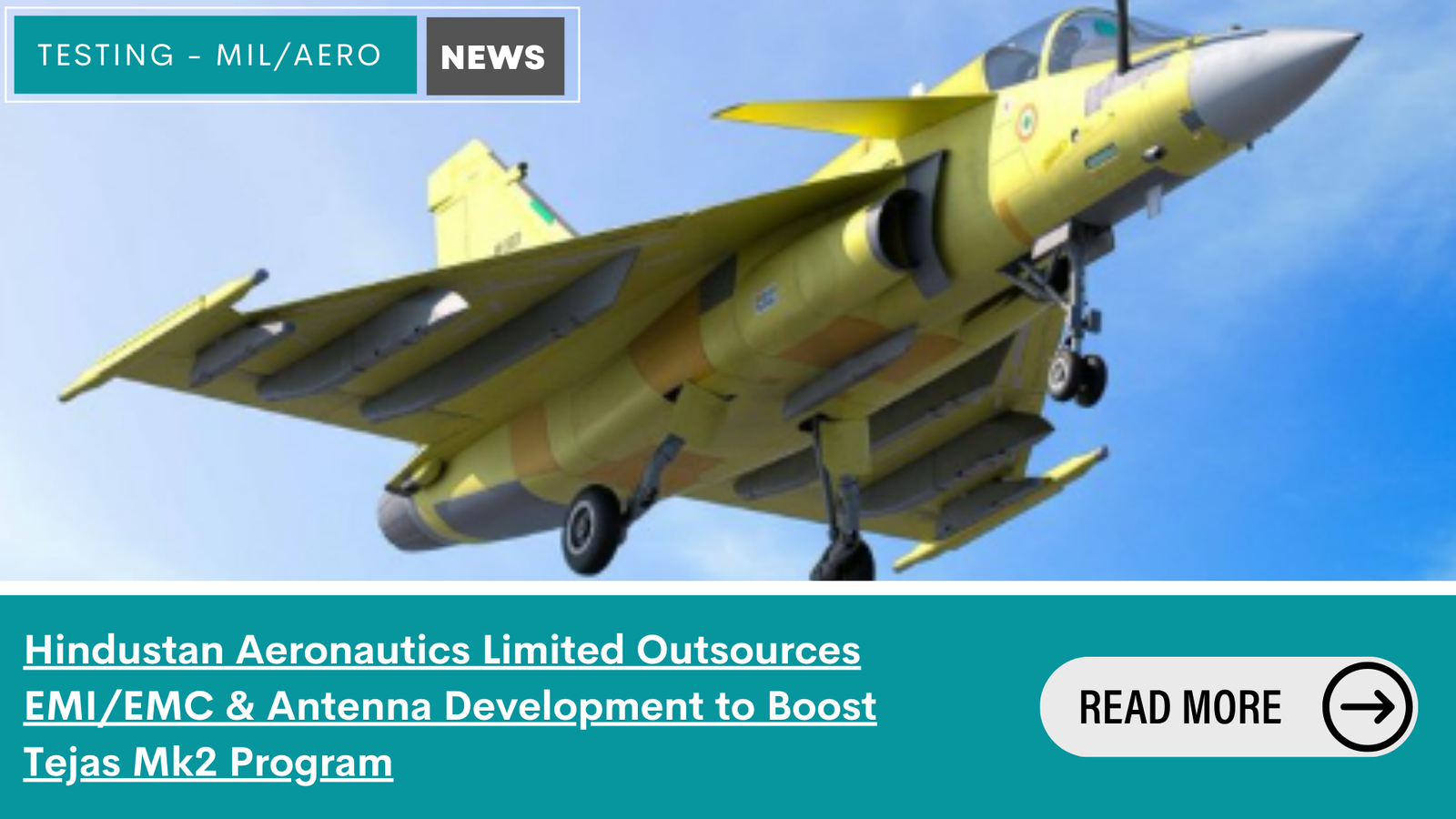
Hindustan Aeronautics Limited (HAL) is taking steps to accelerate the development of the Tejas Mk2 fighter jet by outsourcing critical electromagnetic interference and compatibility (EMI/EMC) testing and antenna development to private Indian companies. The move follows the issuance of a three-year Statement of Work (SOW) and reflects a broader push toward specialized industry collaboration under the Atmanirbhar Bharat initiative.
Also Read: What is the difference between EMC and EMI?
The Tejas Mk2, a 4.5-generation fighter aircraft, integrates advanced radar, communication systems, electronic warfare suites, and mission computers. Ensuring electromagnetic compatibility among these systems is a key technical requirement, making EMI/EMC certification one of the most critical milestones in the program.
Under the SOW, private firms will carry out laboratory-level and full-scale aircraft mockup testing in compliance with international standards such as MIL-STD-461 and RTCA/DO-160. The testing is intended to verify the aircraft’s resilience to internal electromagnetic interference as well as external electronic threats, including jamming. HAL expects this approach to help avoid certification delays experienced during earlier Tejas variants.
Antenna development forms another major component of the outsourcing effort. The Tejas Mk2’s aerodynamic airframe can affect signal propagation, with potential implications for navigation, communication, and identification systems. Private partners will apply advanced electromagnetic modeling techniques to determine optimal antenna placement, aiming to reduce rework, development costs, and overall program timelines.
The Tejas Mk2 will incorporate antennas supporting V/UHF communications, TACAN, VOR/ILS, GPS, IFF, and electronic warfare systems, including radar warning receivers and jammers.
The contract also provides for long-term support activities, including periodic antenna performance evaluations at Indian Air Force bases. These assessments may incorporate AI-driven analytics to support predictive maintenance and sustained operational readiness.
HAL’s engagement with private industry is expected to strengthen India’s defence manufacturing ecosystem, accelerate the Tejas Mk2 development cycle, and support the timely induction of the aircraft into Indian Air Force service.