
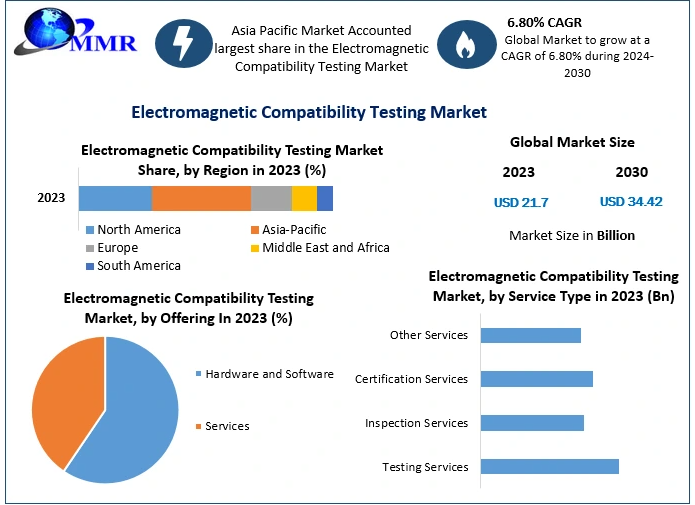
The global Electromagnetic Compatibility (EMC) Testing Market was valued at USD 21.7 billion in 2023 and is projected to reach approximately USD 34.42 billion by 2030, growing at a CAGR of 6.80% during the forecast period. Electromagnetic Compatibility (EMC) refers to a system’s ability to function properly in its electromagnetic environment without introducing or falling victim to electromagnetic interference (EMI). As smart homes, digital infrastructure, and IoT-connected devices become mainstream, demand for electronics has risen sharply across industries such as automotive, aerospace, healthcare, and consumer electronics.
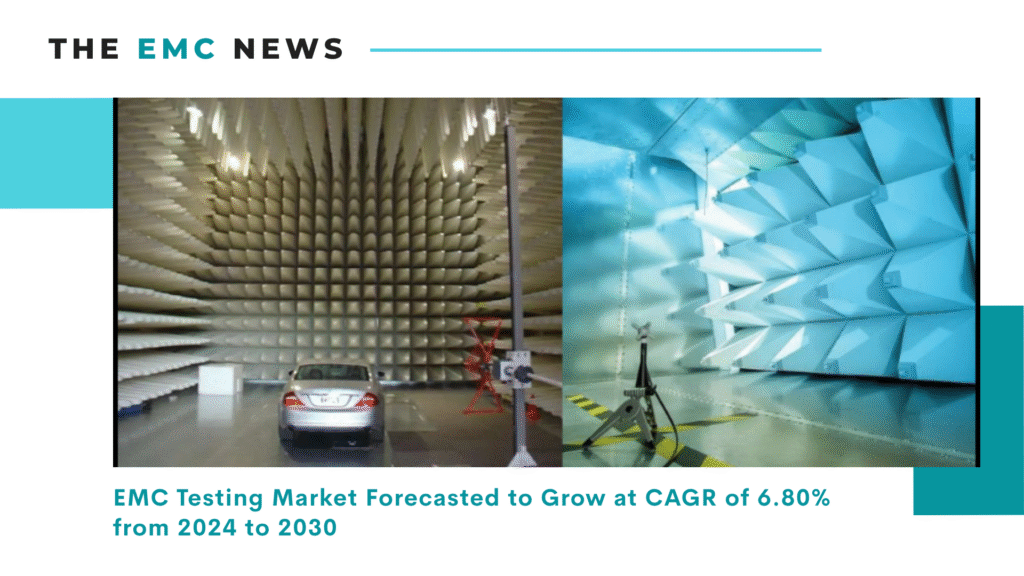
EMC testing ensures that electronic products meet regulatory and performance standards for electromagnetic emissions and immunity. Testing facilities offer inspection and certification services throughout the supply chain—from manufacturers to end users—to verify compliance with international norms and customer requirements. This is essential for market access, safety assurance, and brand reputation.
Market Dynamics
The EMC testing market is experiencing strong momentum, fueled by the growing complexity of electronic systems and the need for interference-free operation in increasingly dense environments. Factors such as the mandatory testing of medical devices, harmonization of global standards, and rising brand differentiation are contributing to market growth.
The rollout of advanced mobile networks—4G, LTE, and 5G—has increased the need for precise EMC testing. As communication infrastructure becomes more sophisticated, high-frequency devices must be rigorously evaluated for compliance and reliability. Similarly, the rising deployment of nuclear power plants and industrial automation systems underscores the need for robust EMI protection.
However, the market also faces challenges. The high cost of specialized testing equipment and a shortage of skilled personnel can limit adoption, especially among smaller firms. Moreover, rapid technological shifts require continuous upgrades in test setups and methodologies, placing pressure on service providers and equipment vendors alike.

Outlook and Future Trends
The future of the EMC testing market appears promising, underpinned by tightening global regulatory standards and the technological evolution of electronic systems. The accelerating adoption of electric vehicles (EVs), 5G connectivity, and wireless communications is expected to drive the need for more comprehensive and early-stage testing.
As Industry 4.0 gains momentum, the rise of autonomous systems, connected infrastructure, and IoT-enabled devices will further expand the scope of EMC testing. Growing interest in pre-compliance and in-house testing is expected to open up new opportunities for both test equipment manufacturers and third-party labs.
Recent Developments
The EMC testing landscape is evolving rapidly to keep pace with industry demands:
Element, a leading EMC/EMI testing provider, offers one of the most extensive service portfolios, ranging from miniature wearable and implantable devices to large infrastructure and in-situ evaluations.
In response to evolving global regulations and the shift toward electrified mobility, manufacturers and test labs are increasingly focused on:
Upgrading testing equipment such as amplifiers and spectrum analyzers, for 5G readiness.
Conducting component-level compliance assessments of batteries, control units, and electronic systems.
Developing next-generation, high-power EMC testing solutions.
Industry players are also leveraging automation, AI-driven tools, and cloud-based platforms to streamline workflows and accelerate time-to-market.
Collaborations between automotive OEMs and EMC labs have become more prominent, particularly for testing electric vehicles and Advanced Driver Assistance Systems (ADAS). Expansion into emerging markets is also underway, with new labs being established to meet rising regional demand for certified electronics.